

Affordable Trendy Clothing for Women: A 2026 Guide
Table of Contents
- Why Affordable Trendy Clothing Doesn't Mean Cheap Quality
- How to Spot Quality Materials and Construction
- Building a Budget-Friendly Capsule Wardrobe
- How to Style Trendy Clothes on a Budget
- Where to Find the Best Online Clothing Boutiques
- Shopping Smarter: Sales, Discounts, and Second-Hand Finds
- Your Next Steps to a Trendy, Affordable Wardrobe
- Frequently Asked Questions
Last Updated: September 9, 2026
Why Affordable Trendy Clothing Doesn't Mean Cheap Quality
The search for affordable trendy clothing for women often ends in disappointment when a $20 top falls apart after two washes. That experience has taught many shoppers to equate a low price point with poor construction, but the equation is flawed. At KennyJax, every piece in our collection is handpicked and approved by the owner before it ever reaches the site.
The real distinction lies in how a garment is made, not what it costs. A common mistake is assuming that fast fashion giants offer the only cheap options, but their low prices often come from cutting corners on fabric and labor. In contrast, a curated online boutique can offer competitive pricing by maintaining a lean inventory and avoiding the massive overhead of physical retail locations. The key is learning to read the garment itself. When you understand what makes a seam durable or a fabric substantial, you can spot true value regardless of the tag, and you stop wasting money on items that look trendy for one season but fall apart before the next.
How to Spot Quality Materials and Construction
Most shopping guides tell you to 'check the seams' and 'feel the fabric,' but they rarely explain what you are actually looking for. This section digs into the technical specifics of fabric quality analysis, giving you a framework to evaluate a garment in under two minutes, whether you are in a store or reading an online material list.
Understanding Fiber Composition
The material label is your first clue. Here is how to interpret common fibers found at budget price points:
- 100% Cotton: Look for a thread count or a mention of 'combed' or 'long-staple' cotton. Long-staple fibers (like Egyptian or Pima cotton) are spun into smoother, stronger yarns that resist pilling (peer-reviewed research). Short-staple cotton, common in cheap tees, frays and pills quickly. A good budget test: hold the fabric up to the light. If you can see a grid of loose, fuzzy fibers, it is likely short-staple.
- Cotton-Polyester Blends: A 50/50 or 60/40 cotton-poly blend is often the workhorse of affordable clothing. The polyester adds wrinkle resistance and durability, while the cotton adds breathability. The key is the knit structure. A 'slub' knit (which has a slightly textured, irregular surface) is trendy but often indicates a looser, less durable weave. A 'jersey' knit that is dense and smooth is a better bet for longevity.
- Polyester and Nylon: These synthetics are not inherently bad. The issue is the denier (thickness) of the fiber. A cheap polyester blouse feels thin and 'slippery.' A higher-quality polyester, often used in activewear, feels substantial and has a matte finish. Look for 'brushed' polyester for warmth or 'microfiber' for a softer hand feel.
- Rayon and Viscose: These are semi-synthetic fibers made from wood pulp. They drape beautifully and are common in affordable dresses and blouses. The weakness is that they can shrink and lose shape when washed. A quality rayon garment will have a tighter weave and will often be labeled 'dry clean only', a signal that the manufacturer knows it is delicate. If you are buying rayon, plan to hand-wash it in cold water.
The 'Twist and Snap' Test for Knits
For t-shirts and sweaters, the most reliable test is the 'twist and snap.' Gently twist a corner of the fabric in your hand, then release it quickly. A quality knit with good 'recovery' will snap back to its original shape almost instantly. A poor-quality knit will stay wrinkled or slowly unfold. This tests the elastane (spandex) content and the tightness of the yarn twist. A cheap tee with low recovery will bag out at the elbows and neckline after a few hours of wear.
Seam Construction: The 'Flat Seam' Rule
Look at the inside of the garment. A quality piece will have a flat-felled seam (common in denim and workwear) or a French seam (common in higher-end dresses), where the raw edges are enclosed. Budget clothing often uses a simple overlock stitch (a serged edge). An overlock stitch is fine if it is tight and even, but it will unravel if the thread is loose. Run your finger along the seam. If you feel any gaps or see the fabric puckering, the tension is off, and the seam will likely fail. Also, check the hem: a quality hem is often a 'blind hem' (nearly invisible from the outside) or a deep double-fold hem. A cheap, narrow single-fold hem will pull and wave after the first wash.
The 'Weight and Drape' Check
Finally, assess the garment's weight. Hold it on a hanger. Does it hang with a clean drape, or does it cling and wrinkle? A heavy fabric is not always better; a lightweight linen-blend can be high quality. The key is the 'hand feel', the fabric should feel substantial for its type. A chiffon blouse should have a slight crispness, not feel like tissue paper. A denim jacket should have a firm, rigid structure (unless it is specifically labeled as 'stretch').
Building a Budget-Friendly Capsule Wardrobe
A budget-friendly capsule wardrobe is a curated collection of versatile pieces that mix and match to create dozens of outfits, rather than a closet full of single-use items. This approach is the antidote to trend-first shopping because it forces you to focus on elevated basics that have staying power. Start with a neutral color palette, think black, white, cream, and denim, and build out from there with a few statement pieces that reflect current seasonal trends.
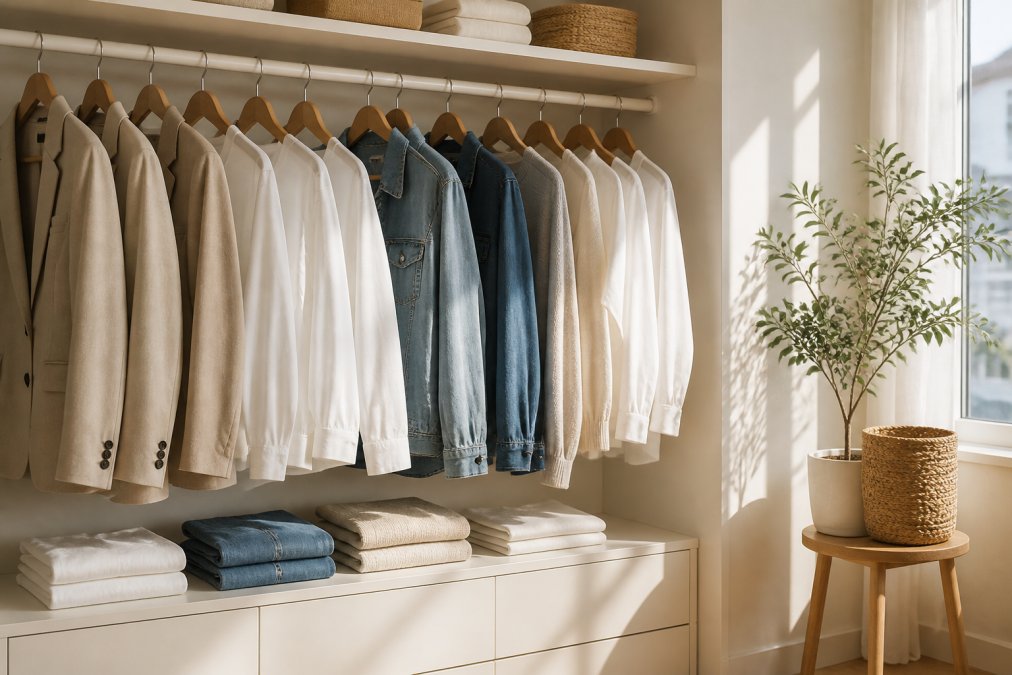
The goal is to maximize cost-per-wear, which is the true metric of value. A $40 pair of jeans worn 100 times costs 40 cents per wear; a $15 fast fashion top worn twice costs $7.50 per wear (extension.iastate.edu). The latter is the real budget killer. To start, focus on these core items that form the foundation of any stylish rotation:
- Two to three quality t-shirts in neutral tones
- One well-fitting pair of dark-wash jeans and one lighter pair
- A versatile blazer or structured jacket for layering pieces
- A simple dress that works for both casual and formal settings
- One pair of comfortable, stylish shoes that go with everything
How to Style Trendy Clothes on a Budget
Styling trendy clothes on a budget is less about buying every new look and more about integrating a few fashion-forward pieces into a wardrobe of classics. The trick is to let the trend be the accent, not the entire outfit. Instead of buying a full matching set in a loud print, purchase one trendy top and pair it with your existing neutral trousers. This instantly modernizes your look without requiring a complete overhaul, and it keeps your style feeling fresh without the financial drain.
A practical method is the "rule of three": when you see a trend you like, wait three days before purchasing. If you still want it, look for one high-quality version rather than three cheap approximations. This prevents impulse buys that end up unworn. For example, if wide-leg trousers are the current seasonal trend, buy one pair in a quality fabric that you can dress up with heels or down with sneakers. This approach allows you to participate in trends while maintaining a personal aesthetic that doesn't look like a copy of a catalog page.
Where to Find the Best Online Clothing Boutiques
The best online clothing boutiques for affordable trendy clothing are those that offer a distinct point of view and detailed product information, not just the lowest prices. When evaluating an online boutique, look for clear photography that shows the garment on different body types, thorough descriptions of the fabric and fit, and a transparent return policy. A retailer that offers free returns is signaling confidence in their sizing, which is a major advantage when you cannot try items on in person.
To help you navigate the landscape, here is a breakdown of what different types of retailers offer, based on common patterns across the market:
- Mass-Market Retailers (e.g., Target, Walmart): These are the entry point for budget fashion. Target's in-house brands like Wild Fable and A New Day are known for trend-forward pieces at price points typically between $15 and $40. Walmart's Scoop and Time and Tru lines offer even lower price points, often $10 to $25, but quality can be more variable. The advantage is ubiquitous access and easy returns, but the downside is that you will likely see your outfit on someone else.
- Pure-Play Fast Fashion (e.g., Shein, Fashion Nova): These offer the absolute lowest prices, often under $15 for a top. However, the trade-off is significant: fabric quality is often thin, sizing is inconsistent, and the environmental and ethical costs are well-documented. If you choose this route, stick to simple, structured pieces like knit tanks or trousers where fit is more forgiving, and avoid anything with complex zippers or lining.
- Curated Online Boutiques (e.g., Lulus, Abercrombie & Fitch's curve love line): These sit in the $30-$80 sweet spot. They offer a middle ground: more curation than mass market, better quality than ultra-fast fashion, and frequent sales. Lulus, for instance, is a strong resource for occasion wear and dresses under $100. Abercrombie has successfully repositioned itself with its 'Curve Love' jean line, which addresses the waist-gap fit issue, and its 'Best Dressed' denim collection often runs $60-$90, frequently on sale.
- Off-Price and Discount Retailers (e.g., T.J. Maxx, Nordstrom Rack): These are treasure hunts. You can find premium brands at 30-60% off, but the inventory is unpredictable. The key is to know your measurements and your favorite brands' sizing, because you cannot rely on trying things on in a fitting room that may be closed or crowded. A significant concern for online shoppers is whether the item will match the photos. Boutiques that use natural lighting and minimal editing provide a more accurate representation of the color and texture.
A practical mechanism for comparing these options is to calculate the cost-per-wear before you buy. A $45 top from a curated boutique that lasts 30 wears costs $1.50 per wear. A $12 top from a fast-fashion site that loses its shape after 3 washes costs $4.00 per wear. The math favors the slightly higher initial investment if the garment holds up.
For a unique, curated selection, family-owned businesses often provide a level of care that larger operations lack. KennyJax operates on a simple promise: every item is handpicked with love to ensure quality, and the business backs that with free shipping and free returns to make the experience risk-free.
Shopping Smarter: Sales, Discounts, and Second-Hand Finds
Smart shopping extends beyond the sale section; it involves a strategy for when and how you buy. One of the most effective tactics is to sign up for email lists to access exclusive discount codes, but create a dedicated inbox folder so promotional emails do not clutter your main account. Another key is understanding the "shipping threshold"; many retailers offer free shipping only above a certain cart value, so plan your purchases to hit that mark rather than paying for delivery on a single item.
Integrating second-hand and resale platforms into your rotation is another way to stretch a budget while embracing sustainable fashion. Thrift stores and online resale apps are excellent sources for quality materials and unique vintage pieces that no one else will have. A common mistake is overlooking menswear sections for oversized blazers or button-downs, which can be styled for a chic, relaxed look. When combining new and used items, remember that a wardrobe built on a mix of durable new essentials and unique second-hand finds is both more interesting and more sustainable than one filled entirely with new fast fashion purchases. According to the Environmental Protection Agency's guide on sustainable management of textiles, extending the life of clothing through resale and repair significantly reduces waste, making this a choice that is as good for your wallet as it is for the planet.
Your Next Steps to a Trendy, Affordable Wardrobe
Building a wardrobe that balances style and budget requires a shift in mindset from buying more to buying better. The journey starts with auditing what you own, identifying the gaps, and then making intentional purchases that fit your style and your budget. Focus on cost-per-wear, learn to spot quality construction, and do not be afraid to mix high-end basics with trendy second-hand finds.
The challenge is patience; it is tempting to buy everything at once, but a curated wardrobe takes time to build. When you are ready to refresh your rotation with pieces that are handpicked for quality and style, explore the latest arrivals at KennyJax. With free returns and fast shipping in 2-3 days, you can experiment with new looks without the financial risk, and build a collection that truly reflects your individuality.
Frequently Asked Questions
What is the 3-3-3 rule for a capsule wardrobe?
The 3-3-3 rule is a simple styling method to create multiple outfits from a few pieces. You pick three tops, three bottoms, and three layers (like jackets or cardigans). Mixing and matching these nine items creates many different looks for the week. It is an excellent framework for building a budget-friendly capsule wardrobe because it forces you to focus on versatile pieces that work together.
How can I tell if affordable trendy clothing is good quality?
Check the fabric content first. Natural fibers like cotton, linen, and wool, or blends with a high percentage of them, usually last longer than pure synthetics. Examine the seams to ensure they are straight and tight, and look for a finished hem. A heavier weight fabric often signals better durability. Reading customer reviews can also give you honest feedback on how a piece holds up after washing.
How do I find unique, handpicked trendy apparel without overspending?
Look for smaller, family-owned online boutiques that curate their collections rather than stocking massive catalogs. These retailers often have a clear point of view and focus on quality materials over quantity. Shopping this way helps you avoid the disposable feel of fast fashion. You get distinctive pieces that won't be on everyone else, which often have a better cost-per-wear value.
What are the best ways to style trendy clothes on a budget?
Focus on buying a few trend-forward statement pieces, like a bold printed top or a unique jacket, and build your outfit around classic, affordable basics you already own. This approach lets you participate in seasonal trends without a full wardrobe overhaul. Another tip is to use accessories, like belts or scarves, to update the look of a simple dress or a plain t-shirt and jeans combination.
KennyJax is a family-owned fashion destination dedicated to providing handpicked quality apparel and accessories for men and women. Get started with KennyJax today and discover a curated selection that helps you look and feel your best.