

Best Curated Boutique Clothing Brands 2026
Table of Contents
- What Makes a Boutique Truly Curated in 2026
- The Boutique vs. Dropshipper Warning
- High-Quality Boutique Apparel Brands: What Separates Them
- How to Style Boutique Clothing for Everyday Wear
- Size Inclusivity and Fit: Why It Matters in Curation
- Care and Maintenance of Boutique Fabrics
- Verifying Ethical and Sustainable Sourcing
- Conclusion
- Frequently Asked Questions
Last Updated: September 27, 2026
What Makes a Boutique Truly Curated in 2026
Curated boutique clothing is a hand-selected collection of apparel assembled by a buyer who chooses each piece on purpose, rather than stocking every trend a mass-market algorithm pushes. At KennyJax, a family-owned fashion destination, every item is handpicked and approved by the owner before it reaches the store. That single filter changes what you see. Instead of endless rows of the same fast-fashion basics, you get a smaller, sharper edit.
Cherry-Picked Inventory vs. Algorithm-Driven Shelves
The real split in 2026 is between cherry-picked inventory and algorithm-driven shelves. A retail chain restocks whatever sold fastest last quarter, which pushes sameness. A true boutique does the opposite. It buys in small-batch production runs, keeps inventory selection tight, and swaps pieces out as the season shifts.
The Boutique vs. Dropshipper Warning
A boutique buys inventory up front, warehouses it, and stands behind the garment when it arrives. A dropshipper never touches the product: it lists a supplier's catalog, forwards your order to a third-party warehouse, and pockets the margin. That structural difference is why two stores can show you the same photo and deliver two completely different garments.
How to Verify a Store Before You Buy
Run this sequence in order. Most fake boutiques fail at step two or three.
- Trace the return address. Add an item to cart and read the shipping and return policy in full. A legitimate boutique names a return address you can look up. A dropshipper either buries the address or lists a fulfillment hub that does not match the brand's stated location.
- Reverse-search the product photo. Save the image and run it through a reverse image search. If the same photo appears on a dozen unrelated storefronts under different brand names, you are looking at a supplier catalog, not a curated edit.
- Check the About page for a named buyer. Curated boutiques usually name the owner or buyer and describe how pieces are selected. Dropshippers write vague mission statements with no human attached.
- Read the size chart against the product. A real boutique publishes measurements taken from the actual garment. A dropshipper pastes a generic chart that does not match the fit described in the copy.
- Look at the review pattern. A curated shop accumulates reviews over months tied to specific pieces. A dropshipper's reviews cluster in bursts, often on products that no longer exist on the site.
What Real Curation Looks Like on the Back End
A curated boutique's operations leave fingerprints. Small-batch production runs mean inventory counts are low and specific, a size sells out and stays sold out rather than restocking instantly from an infinite supplier. Product descriptions reference textile weight, fiber content, and construction details because the buyer handled the garment. Photography is shot in-house or by a consistent creative team, so the lighting and styling match across the catalog.
High-Quality Boutique Apparel Brands: What Separates Them
High-quality boutique apparel brands earn trust through garment construction, not marketing. Look at the seams first. Reinforced stitching, matched patterns at the seams, and a lining that sits flat all point to care. Then check the textile quality: does the fabric hold its shape, or does it thin out after one wash?
Garment Construction and Textile Quality Checks
Run these checks before you buy anywhere:
- Seams are stitched, not glued or fraying
- Fabric has slight stretch but springs back
- Buttons and zippers sit straight and move smoothly
- The size chart lists real measurements, not vague labels
- Care instructions are specific
A garment that passes all five is usually worth the price. One that fails two or more rarely is.
How to Style Boutique Clothing for Everyday Wear
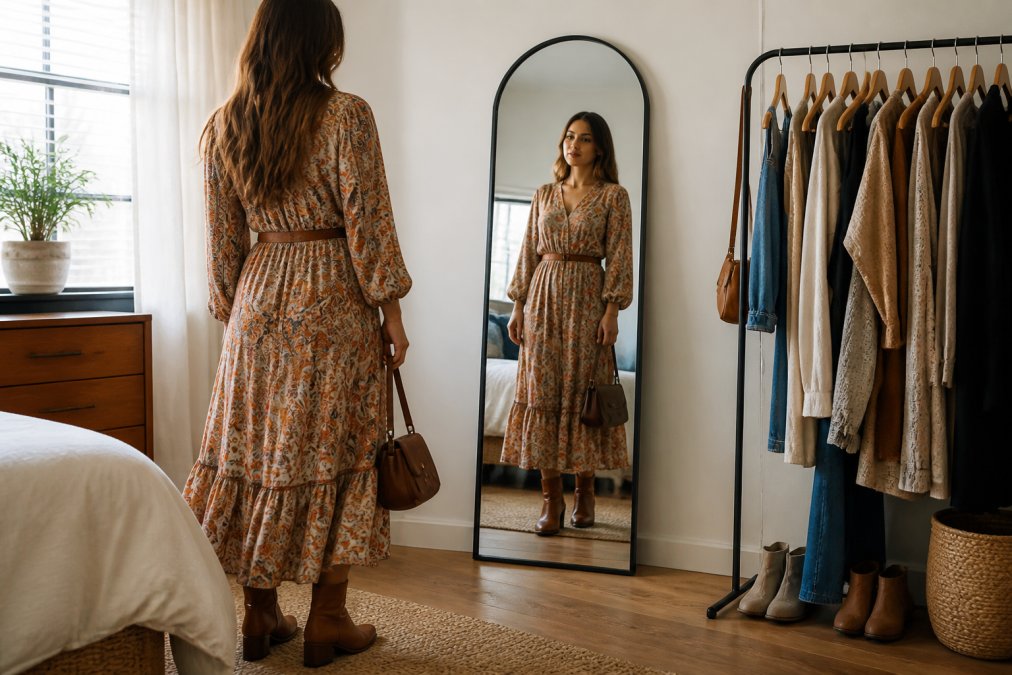
Styling boutique clothing for everyday wear comes down to building around a few strong pieces instead of many weak ones. Start with a capsule wardrobe mindset: pick three or four pieces that mix easily, then rotate them.
Size Inclusivity and Fit: Why It Matters in Curation
Size inclusivity is the test that separates genuine curation from marketing. A boutique that claims to handpick quality but stocks only one narrow size range is not curating for real bodies. Look for detailed measurements and extended sizing.
Care and Maintenance of Boutique Fabrics
Boutique fabrics last longer when you treat them gently. Most of the pieces here are polyester or polyester blends with slight stretch, and those hold up well with basic care. Turn garments inside out before washing, use cold water, and skip the dryer when you can. Heat is what breaks down stretch fibers over time.
Verifying Ethical and Sustainable Sourcing
"Ethical" and "sustainable" are unregulated marketing words in most apparel contexts, which is exactly why they are so easy to abuse. The Federal Trade Commission's Green Guides set the standard for how brands may describe environmental claims, and the agency has repeatedly brought enforcement actions against companies that use vague terms like "eco-friendly" or "green" without substantiation. That gives you a lever: if a boutique leans on those words without specifics, the claim is not just weak, it may be legally exposed.
Layer 1: Trace the Supply Chain
Ask three questions and expect three specific answers:
- Where was the garment made? A country is the minimum. A region or factory name is a strong signal.
- Who made it? A named factory, a named artisan group, or a named partner mill. "Our trusted partners" is not an answer.
- What is it made of? Fiber content with percentages, not "premium blend."
A boutique that answers all three clearly is usually doing the work. One that deflects to a mission statement is not.
Layer 2: Match the Claim to a Certification
Third-party certifications are harder to fake than copy. When a store claims a specific standard, look for the certifying body's mark and verify it in that body's public database. Common ones you will see on boutique labels include Global Organic Textile Standard (GOTS) for organic fiber, OEKO-TEX Standard 100 for chemical safety, and Fair Trade Certified for labor practices. If a store uses the language of a certification without the mark or the certificate number, treat it as unverified.
Layer 3: Read the Care and Longevity Story
The Environmental Protection Agency's textile guidance notes that keeping garments in use longer is one of the most effective ways to reduce fashion waste. That makes care instructions an ethical signal, not just a laundry note. A boutique that publishes specific care guidance, cold wash, lay flat, hang structured pieces, is signaling that it expects the garment to last. A store that ships a generic tag is signaling the opposite.
Layer 4: Watch for Greenwashing Patterns
A few patterns show up again and again:
- A sustainability page that never names a factory, mill, or certification.
- A "recycled" claim with no percentage and no certifying body.
- A capsule collection marketed as ethical while the rest of the catalog carries no sourcing information at all.
- Carbon-offset language used to substitute for supply-chain disclosure rather than supplement it.
KennyJax keeps this simple: a family-owned shop where the owner personally approves each piece, so the sourcing question has a human answer rather than a marketing one. That is the baseline any boutique should be able to meet, and the standard you should hold every store to before you spend.
Conclusion
Frequently Asked Questions
What defines a curated boutique clothing brand?
A curated boutique clothing brand selects each piece by hand rather than stocking hundreds of identical SKUs. The owner or buyer chooses items based on quality, fit, and a consistent style aesthetic, often working with independent designers and small-batch production. This means you see fewer items, but each one earns its place. Curated collections typically emphasize unique silhouettes, premium fabrics, and a point of view you won't find in a mass-market retail chain.
How do I identify high-quality boutique clothing online?
Start with the fabric details: look for specific material names like velvet, corduroy, or a stated polyester blend rather than vague terms. Check whether the brand lists measurements in centimeters for each size, which signals real garment construction knowledge. Zoom in on photos for stitching, lining, and hardware quality. A brand that shows its pieces on multiple body types and provides care instructions is usually more trustworthy than one that only posts styled flat-lays.
Why choose curated boutique brands over fast fashion?
Curated boutique brands focus on small-batch production and handpicked inventory, which means less waste and more attention to garment construction. Fast fashion relies on rapid turnover and wholesale clothing volumes that often sacrifice textile quality. Boutique pieces tend to last longer, fit better, and carry a style aesthetic you can build a capsule wardrobe around. You also support independent designers and local artisans rather than a mass-market supply chain.
What should I look for when shopping at independent boutiques?
Look for transparency: does the boutique name its fabric sources, show real customer photos, and explain its return policy clearly? Check whether sizing is consistent across the collection or varies by designer. Read the about page to see if the owner actually curates the inventory or just dropships. A genuine boutique experience includes personal styling advice, detailed product descriptions, and a willingness to answer questions about fit before you buy.
How do I build a sustainable wardrobe with boutique pieces?
Start with wardrobe staples that work across seasons, like a velvet midi dress or a versatile two-piece set. Choose pieces you can style at least three ways. Focus on textile quality and garment construction so each item lasts. Add seasonal trends sparingly, one or two pieces per season. This slow fashion approach means fewer purchases, but each one gets worn regularly. A capsule wardrobe built from curated boutique pieces often outlasts a closet full of fast-fashion alternatives.
Finding a boutique you can actually trust takes more work than clicking the first ad you see. KennyJax makes it easier with a handpicked collection, free shipping, free returns, and fast 2-3 day delivery, all backed by a family-owned team that stands behind every piece. Browse the latest arrivals and build a wardrobe that feels intentional from the first order.